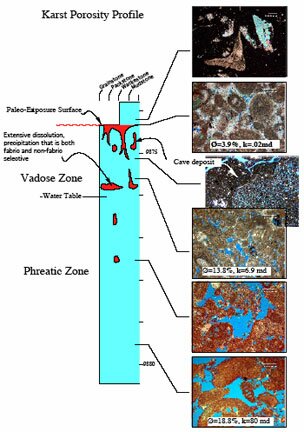
Porosity evolution associated with a karst horizon occurs in highstand systems tract grainstone. Significant porosity destruction exists within a foot of the unconformity. Both calcite and chalcedomy occlude porosity. Actual cavernous porosity was filled with lime mud during subsequent transgressive carbonate deposition. A progressive loss of carbonate cementation can be observed below the karst surface. Solution-enlarged interparticle porosity and maximum permeability developed approximately five to six feet below the unconformity.
|
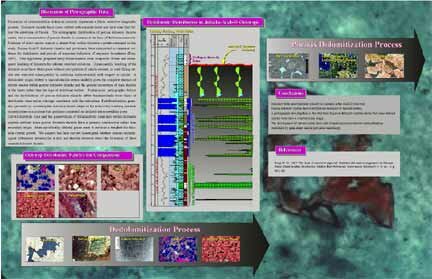
Previous diagenetic studies recognized that anomalously high porosity log readings exist within some Arab-D dolostones because of intracrystalline dolomite porosity. Initial interpretations attributed this form of pore space to dedolomitization processes associated with subaerial exposure. More recent diagenetic investigation demonstrate hat the formation of intracystaline dolomite porosity represents a fabric selective diagenetic dolomite growth process rather than the dissolution of dolomite. Although dolomite rhombs have cores riddled with separate holes that could be interpreted as an early phase of a dedolomitization process, the presence of dolomite rims that follow the skeleton of fossils strongly argues against this. Further, dedolomitization observed in outcrop samples illustrate that the dissolution of dolomite generally proceeds by corroding dolomite rhomb edges or by leaching selectively unstable zones within the crystal to produce continuous rather than isolated intracrystalline pores.
Although variable, the stratigraphic distribution of porous dolomite rhombs is also not consistent with dedolomitization related to subaerial exposure. Porous dolomite crystals are common at the base and never at the top of dolostone intervals as would be expected from diagenetic process related to an unconformity. Instead, stratigraphic and petrographic observations suggest the development of porous dolomite rhombs is more a case of incomplete dolomite crystal development. These observations are also more consistent with the overall stratigraphy, which does not exhibit other digenetic features, cycle stacking patterns or breaks in deposition indicative of subaerial exposure.
Click for here for detailed view.
|