|
Petrographic Reservoir Characterization
Petrographic analysis helps resolve many exploration and reservoir characterization questions that log, seismic and even whole core studies cannot answer. It is particularly beneficial in determining the primary depositional texture, origin and evolution of porosity, reservoir quality, rock typing, the timing of secondary porosity evolution and its implication for fluid migration, the evaluation of diagenetic alteration such as dolomitization, and assessment of anomalous flow behavior. Enhanced petrographic techniques such as diffuse plane-polarized light or blue-light fluorescence are in dispensable for interpreting intensely altered carbonate successions. These petrographic methods can show original depositional fabrics, cyclicity and reservoir quality fabrics that are not resolvable with ordinary petrographic approaches.
|
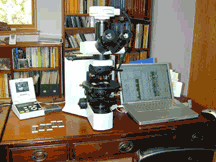 |
Our petrographic system consists of a new Olympus BX-51TRF polarizing microscope and high-resolution DP12-2 Digital camera. Digital displays allow for exceptional computer analysis and statistical presentations of pore system, grain framework, mineralogy, diagenesis and sedimentology. |
 |
Conventional Reservoir Characterization Has Been Qualitative ... Until Now
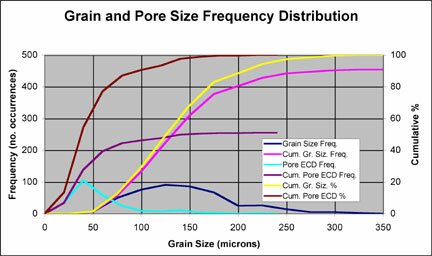
Adaptation of SEM-TEM software for use on petrographic systems equipped with high-resolution CCD cameras, allows exceptionally accurate and repeatable quantification of features in thin-section. Successive measurements vary by less than 0.2%. This enables us to quantitatively describe and analyze in one integrated process the pore system, grain framework, mineralogy, diagenesis and sedimentology for the first time. The derived data can be compared with conventional, routine and special core analysis (i.e. pore area cumulative frequency with a capillary injection curve). Acquisition of large sets of measurements (500-700) is possible in a relatively short period of time. Thus, this type of reservoir description becomes desirable for routine exploration and development decision-making in both conventional and unconventional gas and oil reservoirs. Read more details
|
|
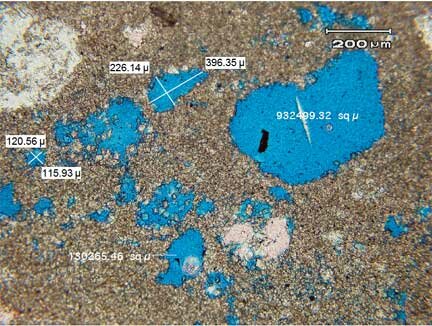
Carbonate reservoirs commonly exhibit extreme petrophysical heterogeneity thanks to the presence of vuggy pore space. Vugs create a complex pore system and change the petrophysical characteristics. Separate-vug pore space is particularly problematic because it increases total porosity but does not significantly increase permeability. Lucia defines seperate vugs as "....pore space that is (1) either within particles or is significantly larger than the particle size (generally >2x) and (2) is interconnected only through the interparticle porosity". The presence of seperate vug porosity introduces the wide variability observed in porosity-permeability crossplots. unless accounted for, it is difficult to develope meaningful transforms or define rock-fabric facies.
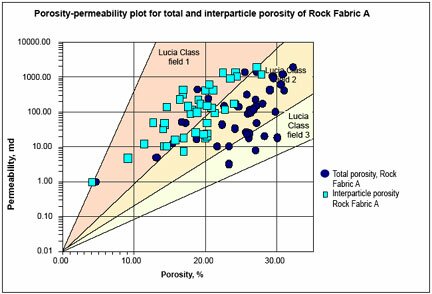
Interparticle porosity-permeability crossplot for carbonate rock fabric A (cl grainstone) with a framework of medium to coarse grain size. Separate vug porosity averages 7 percent for this rock fabric. Given the large amount of separate vug porosity, these samples show significant scatter with samples plotting up in Lucia class field 3, the upper part of 2 and some in the expected class 1. By accessing the amount of separate vug porosity and plotting only the residual interparticle pore space the scatter tightens significantly. Those samples that plot up in Lucia class 2 rather than class 1have interparticle pores filled with very fine pellet sand.
Quantitative analysis of seperate vugs
|
Super-permeability encompases all anomolous rates of production or injection from confined intervals equal to or in excess of 500 barrels of fluid per day per foot. As such it contributes to major reservoir problems such as premature watering-out of wells, water overriding oil and bypassing oil and warrants critical evaluation. Stratigraphic characteristics remain poorly understood for these high permeability intervals but have benefited from a petrographic characterization.
Results of this study were published:
Meyer, F. O., R. C. Price, and S. M. Al-Raimi, 2000, Stratigraphic and petrophysical characteristics of cored Arab-D super-k intervals, Hawiyah Area, Ghawar field, Saudi Arabia: GeoArabia, v. 5, p. 365-394.
. 
(from Meyer, Price and Al-Raimi, 2000)
|
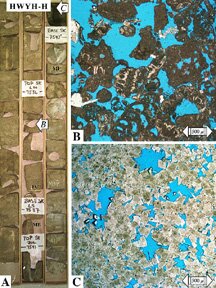
Assessment of rock fabrics in superpermeability zones from Ghawar Field.
(A) Slabbed core: mud-dominated limestones of low permeability (muddy fragmented lithofacies 'mf'') separate coarse fragmented Cladocoropsis lime grainstone ('FC') and a 'case-hardened' dolomite that correlates with the super-k interval.
(B) thin section photomicrograph: sand-size fragments of Cladocoropsis and other altered skeletal grains support a system of large interparticle pores typical of the Cladocoropsis lithofacies (plane-polarized light; plug 45; core depth 7531.2 feet).
(C) thin section photomicrograph: framework of medium dolomite crystals supports the intercrystalline and small-vug porosity in the dolostone interval (blue plastic shows porosity; plane-polarized light; plug 52; core depth 7534.6 feet).
|